
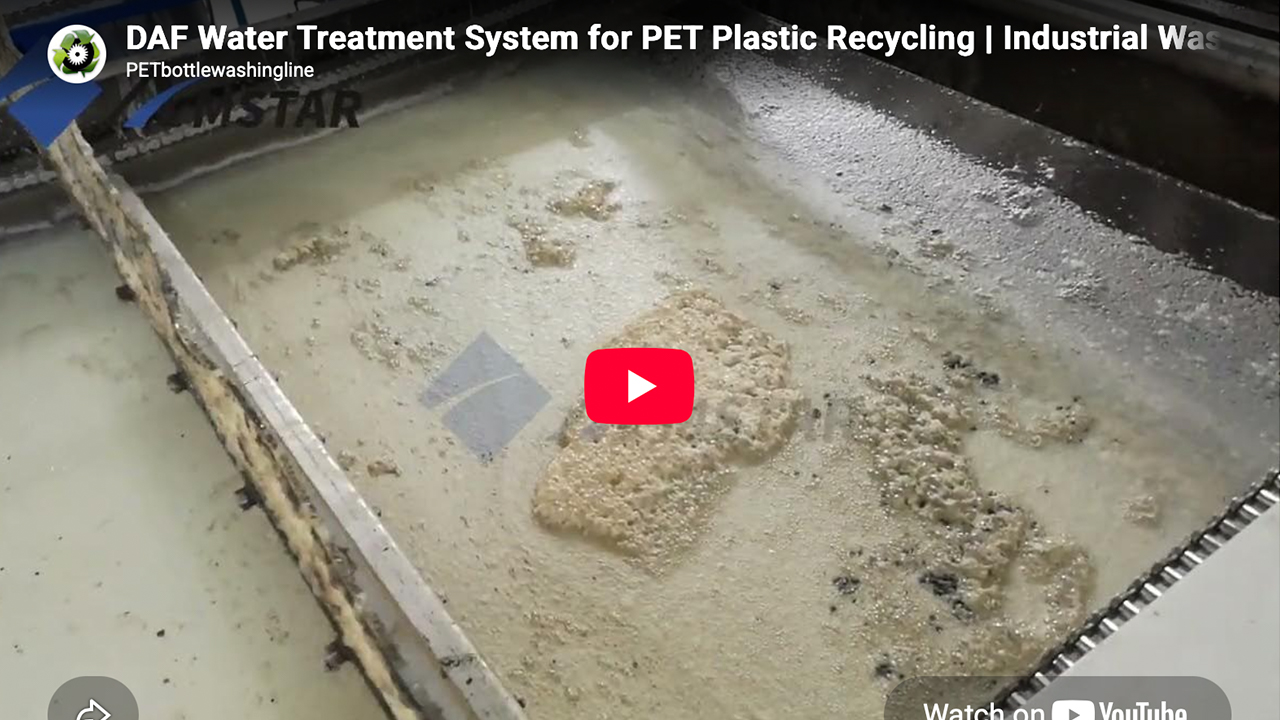
The video shows the wastewater treatment process in real operation, including chemical dosing, floc formation, dissolved air flotation, floating sludge removal, and treated-water clarification.
PET bottle washing is an important stage in the PET recycling process, but it also generates wastewater containing suspended solids and other contaminants from the bottles and labels.
In this video, we take you inside a 15 m³/h DAF Water Treatment System operating at a PET plastic recycling plant. The system uses coagulation, flocculation, and dissolved air flotation (DAF) to separate contaminants from the washing water and prepare the treated water for potential reuse.
What Happens to PET Bottle Washing Wastewater?
Wastewater from PET bottle washing can contain fine particles and suspended contaminants that are difficult to remove through simple screening or settling alone.
The DAF system shown in this video is designed to improve the separation of these fine contaminants through a combination of chemical treatment and flotation.
1. PAC and PAM Dosing
Before entering the flotation unit, the wastewater passes through a reaction stage where PAC and PAM are automatically dosed.
PAC, or polyaluminum chloride, acts as a coagulant, while PAM is used as a flocculant. Together, they help small suspended particles combine into larger flocs.
This preparation improves the ability of the DAF unit to separate fine contaminants from the water.
2. Dissolved Air Flotation
The conditioned wastewater then enters the Dissolved Air Flotation (DAF) tank.
Inside the flotation unit, fine air bubbles attach to the formed flocs. The combined bubbles and particles rise to the water surface, where they form a floating sludge layer.
This is the key separation stage of the system.
DAF technology is widely used for removing suspended matter from industrial wastewater, and it is also used as part of wastewater treatment processes in PET recycling.
3. Floating Sludge Removal
As the contaminants accumulate at the surface, the DAF scraper continuously removes the floating sludge.
In the video, you can clearly see the concentrated layer of separated material being collected from the flotation tank.
This sludge can contain contaminants generated during the PET washing process, including label fibers, adhesive residues, fine plastic particles, and other suspended solids.
4. Treated Water
After flotation and solids separation, the water leaving the DAF unit is visibly clearer than the incoming wastewater.
Depending on the required water quality and the overall treatment process, DAF-treated water can be sent to additional treatment or reused in appropriate stages of a PET bottle washing line.
Water reuse can help recycling plants reduce their demand for fresh process water and decrease the volume of wastewater requiring discharge.
What Can DAF Remove from PET Washing Wastewater?
The contaminants present in PET recycling wastewater vary depending on the source material and washing process.
For PET bottle washing applications, the DAF process can help separate suspended and floating contaminants, including:
- Label fibers and fragments
- Adhesive and glue residues
- Fine plastic particles
- Suspended solids
- Other coagulated particles
The actual treatment performance depends on factors such as wastewater composition, contaminant concentration, chemical dosing, flow rate, and the required treated-water quality.
15 m³/h DAF System for a PET Recycling Plant
The system featured in this video has a capacity of 15 cubic meters per hour (15 m³/h) and is operating at a PET plastic recycling plant.
Rather than showing only the equipment itself, the video demonstrates the treatment process under actual operating conditions.
You can see:
- Automatic PAC and PAM dosing
- Formation of larger flocs
- Microbubble flotation
- Continuous floating-sludge removal
- Clarification of the treated water
The visible sludge layer provides a clear demonstration of how suspended contaminants are concentrated and separated during the DAF process.
Why Treat Wastewater in a PET Recycling Plant?
Water management is an important consideration for PET bottle washing operations. Treating and reusing process water can help plants manage freshwater consumption and wastewater discharge more efficiently.
A wastewater treatment system can be integrated with a PET washing line to create a more controlled water-management process, with additional filtration or treatment stages added when a higher water-reuse quality is required.
For PET recycling plants, the appropriate treatment process should be selected according to the wastewater characteristics, washing-line capacity, required water quality, and intended reuse application.
DAF Water Treatment for PET Bottle Washing
The 15 m³/h DAF Water Treatment System shown in this video demonstrates how dissolved air flotation can be used to separate suspended contaminants from PET bottle washing wastewater.
By combining chemical conditioning, flotation, sludge removal, and water clarification, the system provides an effective treatment stage for PET recycling wastewater.
If you are planning a PET bottle washing line or plastic recycling plant and need a wastewater treatment solution, contact us with your washing-line capacity and wastewater requirements. Our team can recommend a suitable treatment configuration for your application.
Inquiries
To get the latest prices and lead times, send us a message using the form below.