
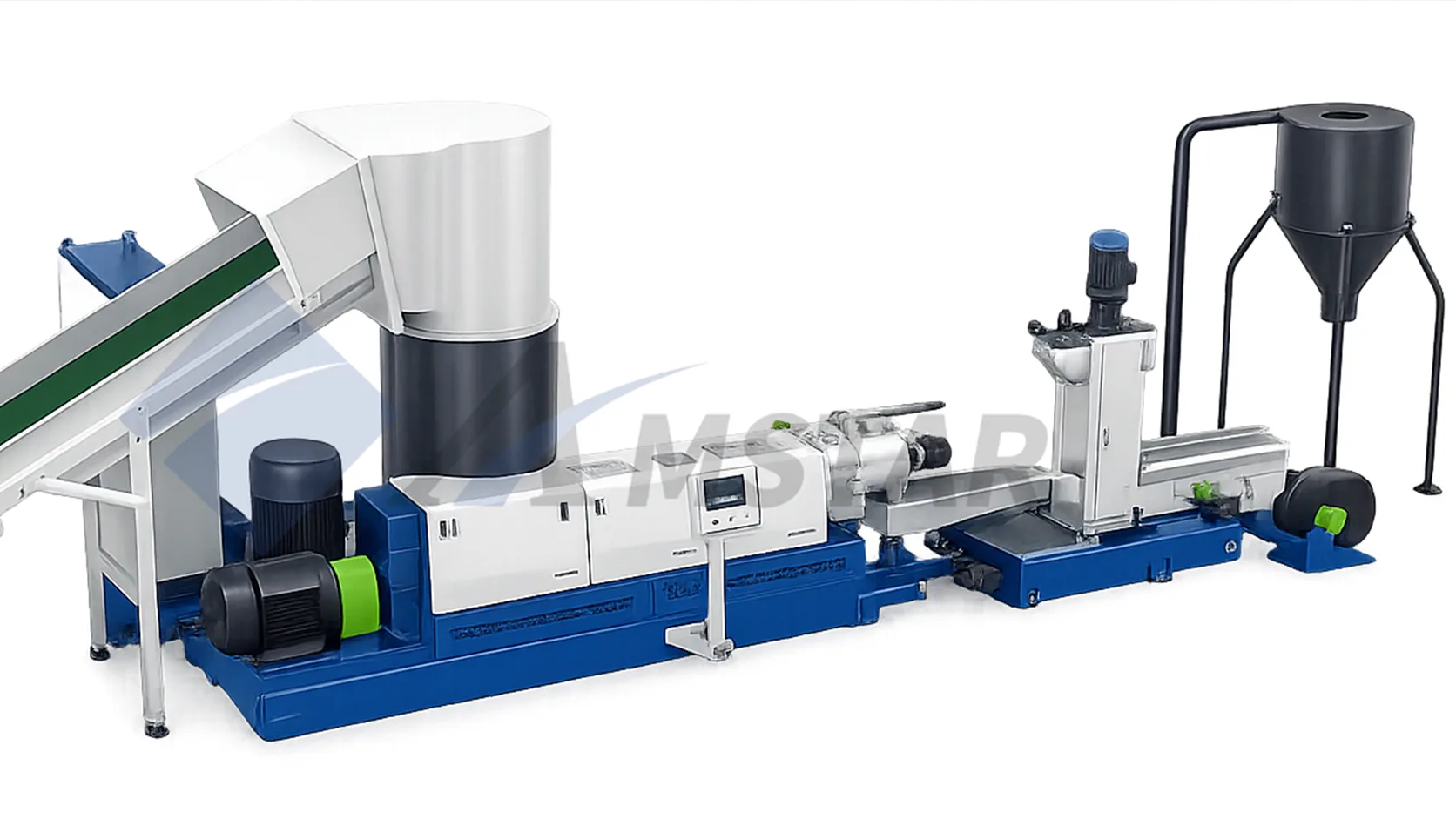

Recycling lightweight plastic film requires more than a standard plastic extruder. Thin film is difficult to feed continuously, easily slips on conventional conveyors, and may cause unstable extrusion pressure.
Our Plastic Film Recycling Machine integrates automatic feeding, film compaction, extrusion, melt filtration, water-ring pelletizing, drying, screening, and storage into one continuous recycling process.

Why This Plastic Film Recycling Machine Performs Better
More Stable Film Feeding
Conventional smooth conveyors may struggle to transport lightweight or overlapping film. The specially designed rough-surface conveyor provides stronger traction and reduces film slipping.
The feeding system is interlocked with the compactor, automatically adjusting the material flow according to the operating condition of the line. An integrated metal detector also helps prevent metal contaminants from entering and damaging downstream equipment.
More Efficient Film Compaction
This produces a more consistent feed, helping reduce bridging, irregular feeding, and pressure fluctuations. The dynamically balanced cutting disc, quick-change blade holders, and automatic cooling system also improve operating stability and simplify maintenance.
Unlike conventional feeding systems that send loose film directly into the extruder, the compactor cuts, mixes, heats, and densifies the material before extrusion.

More Reliable Plasticization
The specially designed single-screw extruder provides stable conveying and uniform melting of compacted plastic film.
A high-torque gearbox, precision temperature control, and effective cooling system help maintain consistent extrusion conditions. Compared with basic extruders, the system provides better control over melt quality and reduces unnecessary thermal stress on the material.
Continuous Filtration without Production Stops
Traditional screen changers often require the extrusion line to stop during filter replacement.
The dual-piston hydraulic screen changer allows the screen to be replaced while production continues. Its enclosed filtration structure helps reduce material carbonization and black spots, while real-time pressure monitoring reminds operators when screen replacement is required.
More Uniform Pellet Cutting
The water-ring die-face cutting system automatically coordinates cutter speed with extrusion output.
A balanced blade-pressure design maintains stable contact between the cutting blade and die surface, helping produce more uniform pellets while reducing uneven blade wear.
Better Pellet Drying and Classification
After cutting, pellets are rapidly separated from process water by the vertical centrifugal dryer. Its forced moisture extraction and side-drainage design improve drying efficiency while providing better protection for the bearings.
The stainless-steel vibrating sieve then removes fines, irregular pellets, and oversized particles before the finished material enters the conveying and storage system.
Smarter and Easier Operation
The complete plastic film recycling machine is managed through an intelligent PLC control system.
Automatic feeding control, temperature monitoring, overload protection, pressure monitoring, and fault checking reduce dependence on manual adjustment. Stored process recipes also make it easier to repeat stable production settings for different plastic film materials.

Conventional System vs. Advanced Plastic Film Recycling Machine
| Conventional Film Pelletizing System | Advanced Plastic Film Recycling Machine |
| Irregular feeding of loose film | Controlled feeding through compaction |
| Film slipping on smooth conveyors | High-grip conveyor surface |
| Manual feeding adjustment | Automatic feeding synchronization |
| Production stops for screen changes | Continuous hydraulic screen changing |
| Unstable cutter pressure | Balanced automatic blade pressure |
| Limited pellet drying | Centrifugal drying and forced moisture removal |
| Single storage point | Pneumatic conveying with flexible storage switching |
| Separate machine controls | Integrated intelligent PLC control system |
A Complete Solution for Plastic Film Recycling
This plastic film recycling machine is suitable for processing clean film edge trims, packaging film waste, rejected film rolls, agricultural film, shopping bags, stretch film, PE film, PP film, LDPE film, LLDPE film, HDPE film, and other post-industrial plastic film scrap.
By combining stable feeding, efficient compaction, controlled extrusion, continuous filtration, and automatic pellet handling, the system converts difficult-to-process plastic film waste into clean, uniform, and reusable recycled plastic pellets.
Frequently Asked Questions
Thin film is hard to feed continuously, slips on conventional smooth conveyors, and can cause unstable extrusion pressure. The film recycling machine solves this with a rough-surface conveyor, a compactor interlocked with the feeder, and a single-screw extruder designed for compacted film.
The compactor cuts, mixes, heats, and densifies the film before it enters the extruder, instead of feeding loose film directly. This gives a consistent feed that reduces bridging, irregular feeding, and pressure fluctuations, while a dynamically balanced cutting disc and quick-change blade holders simplify maintenance.
The dual-piston hydraulic screen changer lets operators replace screens while production continues, unlike traditional screen changers that stop the line. Its enclosed filtration structure reduces material carbonization and black spots, and real-time pressure monitoring reminds operators when a screen replacement is due.
A vertical centrifugal dryer separates pellets from process water using forced moisture extraction and a side-drainage design that also protects the bearings. A stainless-steel vibrating sieve then removes fines, irregular pellets, and oversized particles before the material enters conveying and storage.
The line processes clean film edge trims, packaging film waste, rejected film rolls, agricultural film, shopping bags, stretch film, and PE, PP, LDPE, LLDPE, and HDPE film, plus other post-industrial film scrap, converting it into clean, uniform, reusable recycled pellets.
The PLC handles automatic feeding control, temperature monitoring, overload protection, pressure monitoring, and fault checking, reducing dependence on manual adjustment. Stored process recipes let operators repeat stable settings for different film materials, and an integrated metal detector protects downstream equipment from metal contaminants.
Inquiries
To get the latest prices and lead times, send us a message using the form below.

[…] The video shows the line converting waste PP, PE and BOPP films into reusable pellets. Machine details: Plastic Film Pelletizing Line. […]