
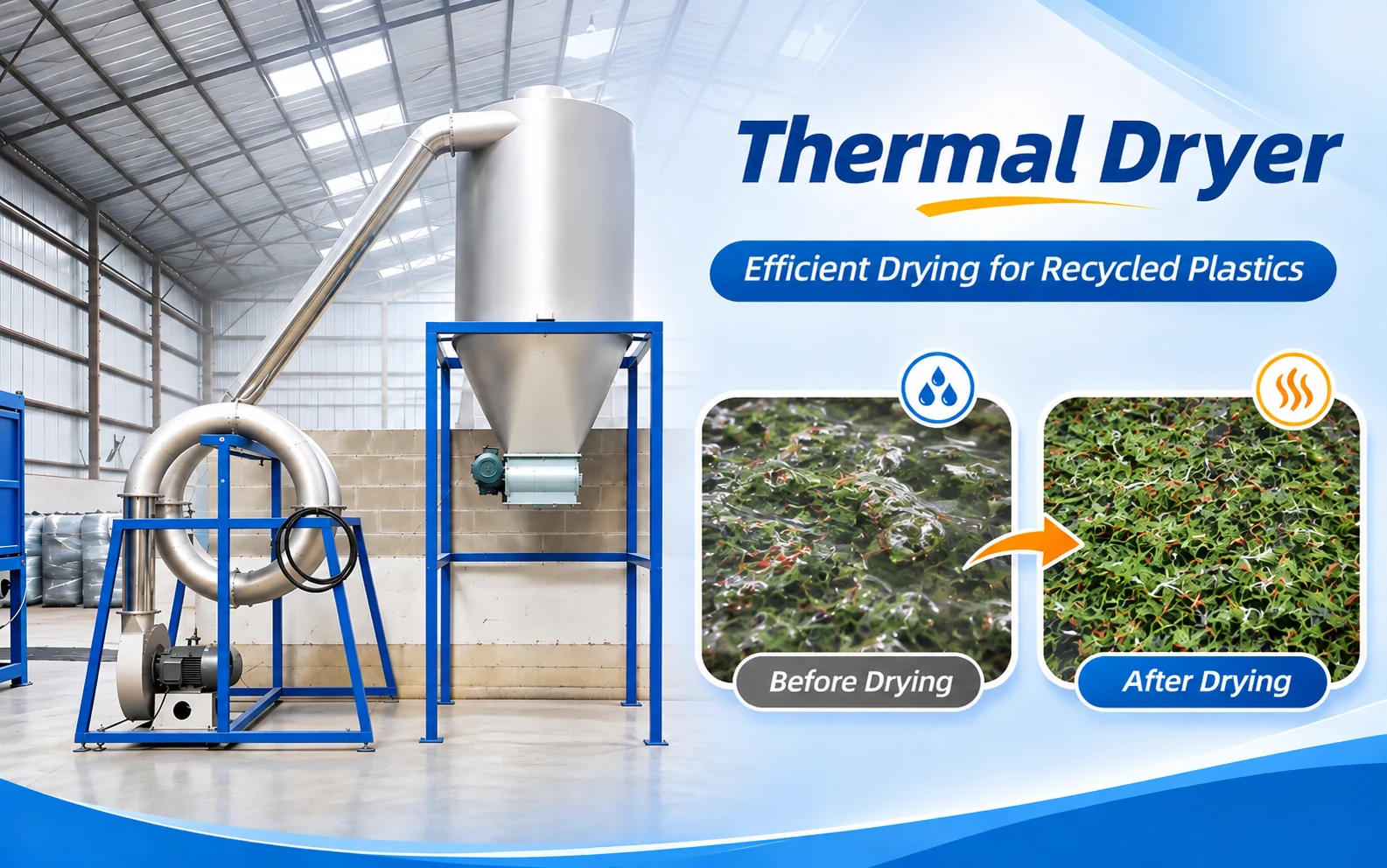
How effective moisture management improves recycled plastic quality, supports stable downstream processing, and helps recycling plants control operating costs.
Quick answer: A thermal dryer uses heated air to reduce remaining surface moisture after plastic washing and mechanical dewatering. Its performance depends on the material, inlet moisture, airflow, temperature and throughput. For hygroscopic polymers such as PET, surface drying alone may not meet the moisture specification for melt processing.
In plastic recycling, washing removes dirt, labels, adhesives and other contaminants. But clean-looking flakes are not necessarily dry enough for storage, sale or extrusion. Residual water can remain on particle surfaces, inside irregular shapes or between overlapping films. A properly engineered thermal dryer addresses this often-overlooked transition between washing and downstream processing.
Rather than viewing drying as a final accessory, recycling operators should treat moisture control as a process-design decision. The right solution depends on polymer type, particle geometry, inlet moisture, production rate and the moisture specification required by the next user of the material.
1. The Hidden Cost of Residual Moisture
Excess water may cause wet packaging and clumping during storage, reduce the flowability of lightweight flakes, and increase the vapor load in extrusion. Depending on the polymer and extruder design, it may contribute to pressure fluctuations, bubbles, inconsistent pellet appearance or higher degassing demand. For moisture-sensitive PET, insufficient pre-extrusion drying can also promote hydrolytic degradation and reduce molecular weight. Alpek’s PET product information explains this absorbed-moisture and hydrolytic-degradation mechanism for a specific resin grade. Recycled feedstock still requires its own drying specification.
Moisture requirements are therefore application-specific. A washed-flake buyer may accept a different specification from a PET sheet producer or a compounder. The correct target should be agreed upon before the drying equipment is selected.
2. Why a Centrifugal Dryer and a Thermal Dryer Work Better Together
Mechanical dewatering removes bulk free water efficiently by centrifugal force or squeezing. Thermal drying then uses heat and moving air to evaporate remaining surface moisture. Using heat to remove water that could first be mechanically separated wastes energy.
| Factor | Mechanical dewatering | Thermal drying |
|---|---|---|
| Primary mechanism | Centrifugal force / squeezing | Evaporation into heated air |
| Best role | Bulk free-water removal | Residual surface-water reduction |
| Energy demand | Primarily motor power | Fan power plus heat input |
| Typical placement | After washing | After mechanical dewatering |
In many rigid-flake washing lines, a centrifugal dryer followed by a pneumatic thermal dryer provides an effective two-stage approach. For film, a squeezing dryer may be more suitable upstream; the final configuration must reflect material behavior.
3. Matching the Dryer to the Polymer
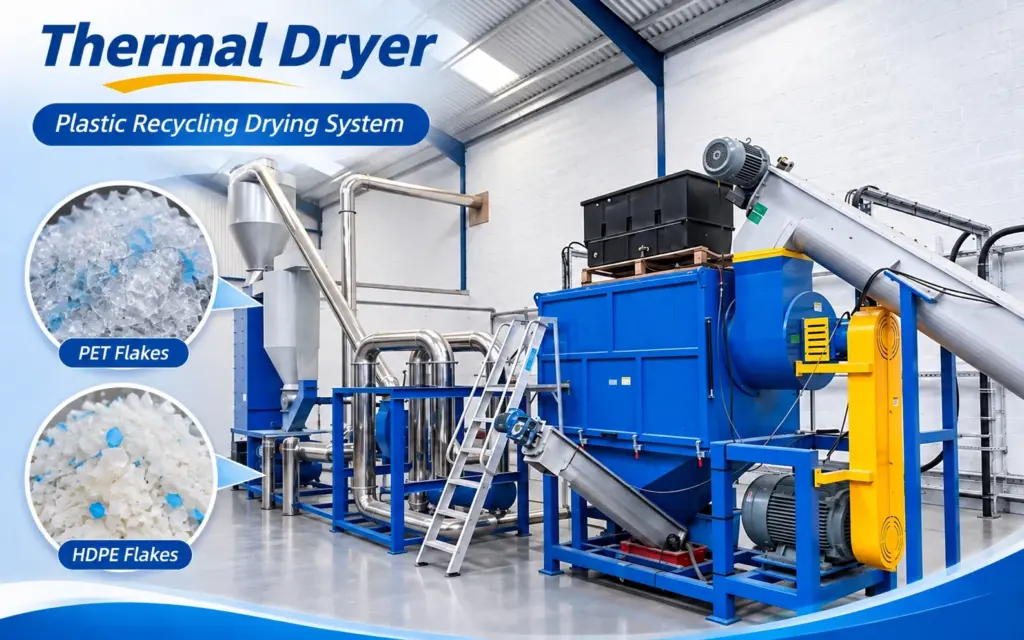
PET bottle flakes
A thermal dryer can remove residual surface water after PET washing and centrifugal dewatering. However, PET is hygroscopic: for moisture-sensitive melt processing, specialized dehumidifying and often crystallization drying may still be required. A washing-line thermal dryer is not a universal substitute for these systems.
HDPE and PP rigid flakes
HDPE and PP absorb relatively little water, so the principal task is usually surface-moisture removal. Centrifugal and thermal drying can be an effective combination, with equipment sized to the flake dimensions and throughput.
LDPE and LLDPE film
Flexible films trap water between folds and layers, while low bulk density complicates pneumatic conveying. Squeezing and densification are often important upstream steps. A thermal dryer must be configured specifically for flexible feedstock rather than copied from a rigid-flake system.
ABS and engineering plastics
Drying requirements vary with polymer grade, temperature sensitivity and downstream application. Where internal absorbed moisture is critical, a dedicated dehumidifying dryer may be necessary.
4. Practical Questions to Ask Before Buying a Thermal Dryer
- What are the polymer type, particle size, bulk density and hourly throughput?
- What are the measured inlet moisture and required outlet moisture, and how will they be tested?
- Which mechanical dewatering stage is installed upstream?
- Is the feedstock rigid flake, loose film or densified material?
- What are the allowable material temperatures and available heat source?
- How will air exhaust, fines collection, cleaning access and temperature safety be handled?
A drying performance claim is meaningful only when test material, feed rate, inlet moisture, measurement method and operating conditions are defined. Outlet moisture figures should not be treated as universal guarantees across all plastics.
Conclusion: Drying Is a Quality-Control Decision
A thermal dryer is not simply a heater attached to a washing line. It is a process component that helps convert washed plastic into a more consistent, manageable feedstock. The best results come from matching mechanical dewatering, airflow, heat input and material characteristics to a clearly defined moisture target.
AMSTAR designs plastic recycling washing and drying solutions around the actual material and production requirements of each project. Whether the application involves PET bottle flakes, HDPE/PP rigid regrind or flexible PE film, the drying system should be selected as part of the complete recycling process.
If you are planning or upgrading a plastic recycling line, contact AMSTAR for a customized washing and drying solution.
A washing line may combine a centrifugal dewatering machine with a thermal dryer; flexible film may instead need a squeezer-densifier upstream. Compare the wider options in the plastic recycling drying technologies guide before specifying the final stage.
Common Questions
What is the difference between a centrifugal dryer and a thermal dryer?
A centrifugal dryer separates bulk free water mechanically. A thermal dryer evaporates remaining surface water into moving heated air. Removing excess water mechanically first can reduce the amount of water that must be evaporated.
What outlet moisture should a plastic recycling dryer achieve?
Set the target from the buyer’s specification and downstream process, then define the test method, feed material, inlet moisture and throughput. One moisture figure should not be treated as a guarantee for every polymer or flake geometry.
Can one thermal dryer handle both rigid flakes and PE film?
Only if it is configured and validated for the actual feedstocks. Loose films can retain water between folds and behave differently in pneumatic conveying. Mechanical squeezing or densification may be needed before thermal finishing.
References
- Alpek Polyester — Laser+ CSD D90A product information, Material Drying (PDF; guidance for a specific PET resin grade)
- Conair — Hot Air Dryers: surface-moisture removal from non-hygroscopic resin (PDF)
INQUIRIES
To learn more about this topic or get prices and lead times for the machinery mentioned, please send us a message using the form below.