
Why the best dryer is not always the hottest or fastest one
Quick answer: Choose plastic recycling drying technology by polymer, moisture type and the next processing step. Mechanical dewatering removes bulk water; hot air finishes surface drying. Hygroscopic polymers such as PET may need a validated low-dew-point or other dedicated drying process before melt processing.
In plastics recycling, drying is more than removing visible water. The right method depends on where the moisture sits, how the polymer responds to heat, and what the next machine needs. A PE film washing line and a PET extrusion line may both require “dry material,” yet their drying challenges are fundamentally different.
Five Technologies at a Glance
| Technology | How it works | Best-fit applications | Trade-off |
|---|---|---|---|
| Hot air drying | Heated airflow and convection | PE, PP; surface-moisture removal | Simple equipment; low upfront cost; Limited for absorbed moisture; efficiency depends on airflow |
| Desiccant dehumidifying | Dry air first, then controlled heating | PET, PA, PC and other hygroscopic resins | Reliable low-dew-point drying; stable in humid climates; Higher capital cost; filters/desiccant need maintenance |
| Vacuum drying | Lower pressure promotes moisture evaporation | Selected high-value or heat-sensitive resins, including some PEEK/PPS processes | Potentially shorter residence time and lower oxygen exposure; Complex controls; batch size and operating costs matter |
| Infrared drying | Radiant energy heats the material directly | Selected flakes, pellets, trials and compact systems | Rapid heating; potentially short residence time; Bed depth and mixing affect uniformity |
| Microwave drying | Electromagnetic energy couples with responsive materials/moisture | Specialized, validated applications | Volumetric heating potential; fast in suitable feeds; Variable coupling, hot spots, shielding and control cost |
Start With the Moisture, Not the Machine
A useful distinction is surface water versus absorbed moisture. Washed PP and PE flakes generally need efficient mechanical dewatering followed by air drying. Hygroscopic polymers such as PET, PA and PC can absorb moisture into the resin; warm air alone may not bring them to a sufficiently low level for melt processing. Their drying strategy must control air dryness, temperature, residence time and material handling. This surface-water/absorbed-moisture distinction is also explained in Conair’s hot-air drying guide and Alpek’s PET drying guidance. The latter concerns a specific PET resin grade; its settings are not universal recycling-line specifications.
1 | Hot Air: The Practical Workhorse
Hot air systems are often the economical finishing stage after a centrifugal dryer or squeeze dryer in film and rigid-plastic recycling. They are straightforward to operate, but adding heat cannot compensate for poor upstream water removal. Optimize airflow distribution, insulation and residence time before increasing heater power.
2 | Desiccant Air: Control the Dew Point
For PET flakes headed to extrusion, the critical issue is not merely hot air but air with sufficiently low moisture content. Desiccant systems deliver conditioned air to support consistent drying, provided the hopper, filters, airflow and regeneration cycle are maintained. Required residual moisture must be specified by the downstream process and verified by measurement.
3 | Vacuum: A Targeted Solution, Not a Universal Upgrade
Reducing pressure can accelerate moisture removal under suitable conditions and may limit oxygen exposure. Vacuum dryers can be attractive for high-value polymers or specialty production, but suitability for PEEK, PPS and other engineering resins must be confirmed against their grade-specific drying windows. Throughput, batch handling and equipment complexity can outweigh theoretical speed gains.
4 | Infrared: Speed With a Mixing Requirement
Infrared energy can heat exposed flakes or pellets quickly. In recycling, it may be integrated with agitation or downstream dry-air conditioning. Its advantage is compact, rapid treatment; its engineering challenge is achieving even exposure when particle size, color, bulk density and bed depth vary.
5 | Microwave: Promising, but Material-Dependent
Microwave drying can generate heat within responsive materials, but not every polymer–moisture combination couples equally well with microwave energy. Uneven feed composition can create temperature variation. For industrial recycling, trials, process controls and appropriate electromagnetic shielding are essential before claiming consistent performance.
A Better Selection Framework for Recycling Plants
Step 1 — Identify the feedstock. Record polymer type, flake or film geometry, initial moisture, contamination and bulk density.
Step 2 — Define the downstream limit. A washed-flake storage specification may differ greatly from the moisture requirement before PET sheet extrusion or engineering-resin compounding.
Step 3 — Remove bulk water mechanically. Centrifugal drying and film squeezing usually reduce the thermal load more economically than heating excess water.
Step 4 — Compare total operating cost. Assess kWh/kg of water removed, installed power, heat recovery, maintenance, labor and achievable throughput—not purchase price alone.
Step 5 — Validate with real material. Run a representative test at rated throughput and measure inlet/outlet moisture, product temperature and energy use.
Application Snapshot
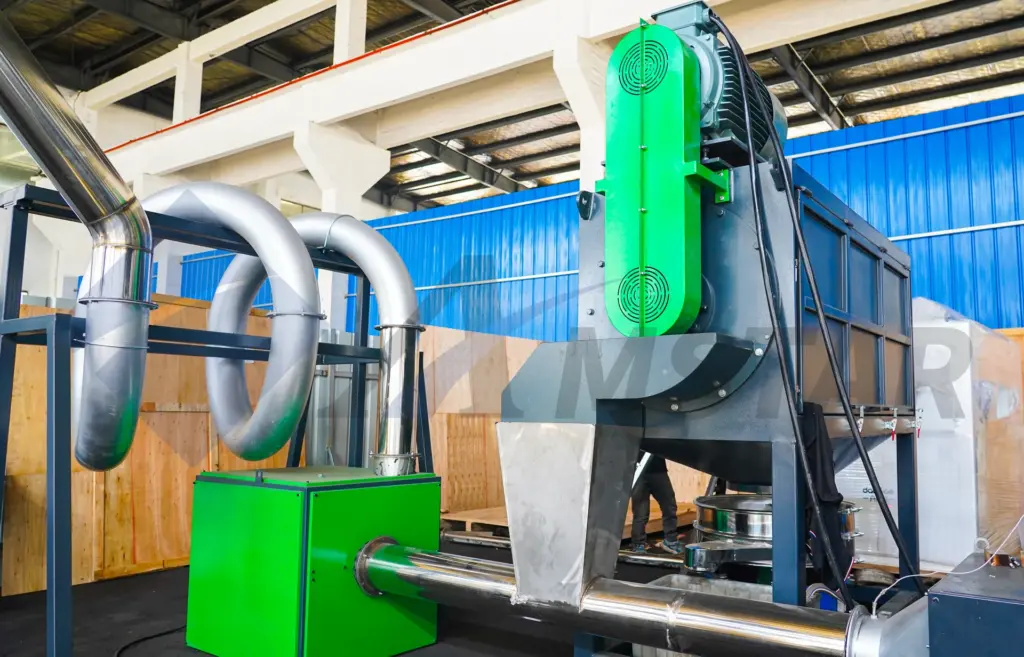
PE/PP film washing: squeezing or centrifugal dewatering followed by controlled hot-air finishing is typically the first option. Rigid HDPE/PP flakes: mechanical dewatering plus air drying is commonly sufficient for surface water. PET flakes for extrusion: specify a low-moisture target and evaluate a dedicated dehumidifying or other validated drying system. High-performance resins: compare desiccant, vacuum and specialized methods using resin-supplier guidance and production trials.
The Takeaway
There is no single “best” plastic dryer. The strongest process design combines efficient upstream water removal with a thermal or low-dew-point stage matched to the polymer and the final application. For recycling-line buyers, the most meaningful quotation is one that guarantees outlet moisture at a defined feed condition and throughput—alongside realistic energy consumption.
Explore integrated washing, dewatering and drying solutions at plasticrecyclingmachine.net.
For washing-line equipment, compare centrifugal dewatering machines, thermal dryers and film squeezer-densifiers. The companion guide to thermal drying and moisture control explains the boundary between washing-line surface drying and preparation for melt processing.
Common Questions
How do I choose a dryer for PP or PE flakes?
Start with measured inlet moisture, particle shape and the downstream moisture limit. Remove free water mechanically, then assess whether controlled hot-air finishing is needed. Check the result with representative material rather than selecting by heater power alone.
Is hot-air drying enough for PET before extrusion?
A washing-line hot-air dryer removes surface water, but PET can also contain absorbed moisture. The downstream process may require dedicated dehumidifying or another validated drying system. Confirm the specification and drying conditions for the actual material.
Which dryer has the lowest operating cost?
There is no universal lowest-cost technology. Compare energy per kilogram of water removed at a defined throughput, together with maintenance, labor and the required outlet moisture. Effective mechanical dewatering can reduce the load on the thermal stage.
References
- Conair — Hot Air Dryers: surface-moisture removal from non-hygroscopic resin (PDF)
- Alpek Polyester — Laser+ CSD D90A product information, Material Drying (PDF; guidance for a specific PET resin grade)
INQUIRIES
To learn more about this topic or get prices and lead times for the machinery mentioned, please send us a message using the form below.