
A practical global outlook on material value, recycling challenges and the machinery needed to turn waste into marketable feedstock.
Industry insights | PlasticRecyclingMachine.net
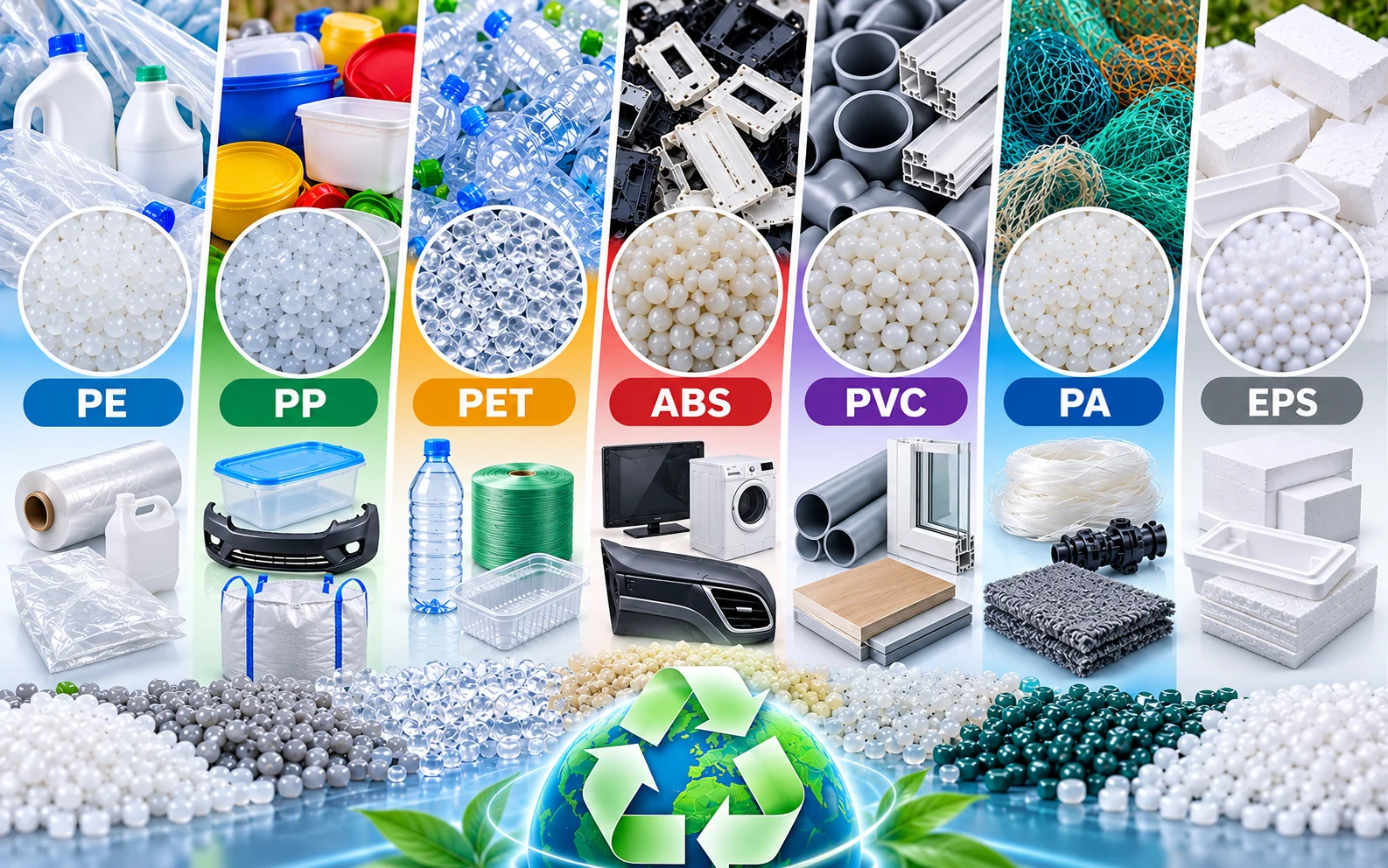
Quick answer: PE, PP, PET, ABS, PVC, PA and EPS have different recycling opportunities. The best fit for a recycler depends on local feedstock, contamination, sorting and drying requirements, processing cost and buyer specifications. The comparison below is a practical assessment, not a market-share ranking or an investment forecast.
The global picture: a large market with a significant recycling gap
The most promising recycled plastic is not necessarily the one with the highest selling price. Commercial success depends on feedstock availability, sorting accuracy, contamination, processing cost, achievable quality and consistent end-market demand. For recyclers investing in equipment, those factors matter more than a headline market-growth forecast.
The OECD estimates that worldwide plastics use reached 460 million metric tonnes in 2019, while plastic waste totaled 353 million tonnes. Only 9% of that waste was ultimately recycled after processing losses. Its baseline scenario projects global plastic waste could reach 1,014 million tonnes by 2060, with recycling accounting for 17% under current-policy trends. These are global, all-polymer figures—not 2026 measurements or individual resin market sizes.
The European Union provides one clear demand signal: PET beverage bottles have a 25% recycled-content target from 2025, while plastic beverage bottles overall have a 30% target from 2030, measured under the applicable rules. This does not automatically make every recycled PET flake food-contact compliant.
01 Recycled PE (HDPE / LDPE / LLDPE) — The volume opportunity
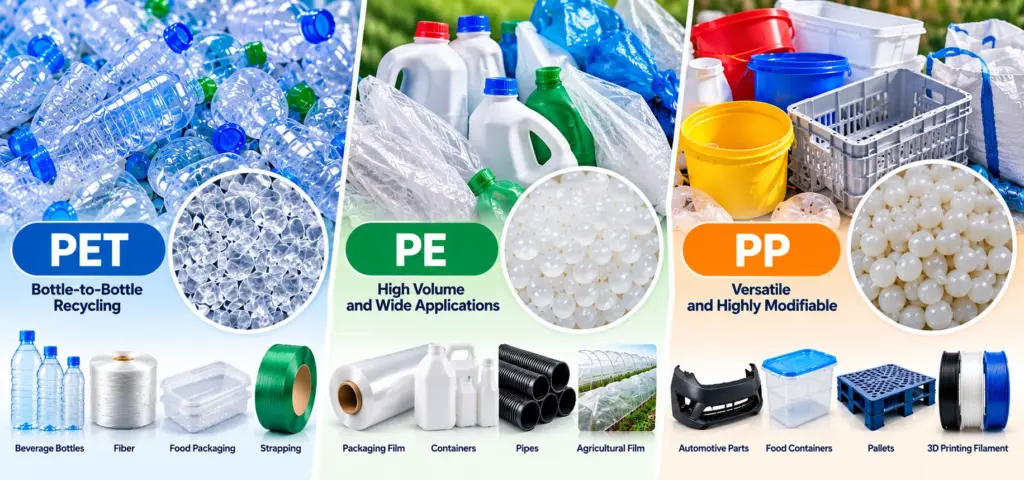
Typical waste: milk and detergent bottles, industrial containers, stretch wrap, shopping bags and agricultural film.
Why it matters: PE appears in enormous quantities across packaging and agriculture. Clean industrial HDPE offers comparatively straightforward reprocessing, while post-consumer film creates demand for more advanced washing and drying.
Main obstacle: sand, soil, labels, moisture and mixed-polymer contamination can destroy margins; low-density film also complicates feeding.
Equipment route: sorting → shredding/granulation → friction and float-sink washing → mechanical drying / film squeezing → extrusion and melt filtration.
Outlook: Strongest for operators with stable feedstock contracts, high water efficiency and reliable pellet specifications.
02 Recycled PP — The versatile compounder
Typical waste: rigid tubs, caps, automotive parts, woven sacks, raffia and industrial scrap.
Why it matters: Recycled PP can serve injection molding, automotive noncritical components, pallets and industrial products. Compounding with stabilizers, fillers or reinforcement can improve selected properties, but formulation must match the final application.
Main obstacle: mixed grades, odors, thermal degradation and inconsistent melt-flow index; food-contact use requires separate regulatory and process validation.
Equipment route: sorting → size reduction → washing and drying where needed → extrusion with degassing and filtration → optional compounding.
Outlook: Attractive where material identification and melt-flow consistency support repeatable customer specifications.
03 Recycled PET (rPET) — The bottle-to-bottle frontrunner
Typical waste: beverage bottles, PET trays and selected polyester industrial streams.
Why it matters: Established bottle collection systems and recycled-content rules support high-quality rPET. Applications range from fiber and strapping to sheet and qualified food-contact packaging.
Main obstacle: PVC contamination, adhesives, colored bottles, fines, moisture and intrinsic-viscosity loss. Food-grade production requires validated decontamination and jurisdiction-specific authorization.
Equipment route: debaling → sorting and label removal → wet granulation → density separation → hot/friction washing → rinsing → dewatering and thermal drying → final optical sorting; further processing depends on product grade.
Outlook: Among the clearest long-term opportunities for high-purity recyclate, particularly where bottle collection and quality assurance are mature.
04 Recycled ABS — Value hidden in durable goods
Typical waste: appliance housings, electronic equipment casings and automotive trim.
Why it matters: ABS retains demand in durable applications where impact resistance, surface finish and dimensional stability are important. Well-sorted industrial or post-consumer ABS can command a quality premium.
Main obstacle: separating ABS from PS/HIPS and other plastics, managing legacy flame retardants and ensuring compliance with restricted-substance rules.
Equipment route: dismantling and pre-sorting → shredding → metal removal → density/electrostatic or sensor sorting → granulation → extrusion and filtration.
Outlook: Higher-value but sorting-intensive; traceability and contaminant testing are essential.
05 Recycled PVC — A specialist in construction loops
Typical waste: pipes, window profiles, flooring and cable coverings.
Why it matters: Long-life building products create opportunities for controlled take-back and closed-loop reprocessing, particularly when rigid PVC streams are kept separate.
Main obstacle: additives, plasticizers, stabilizers, mixed formulations and chlorine-related processing constraints. PVC must be prevented from contaminating PET recycling streams.
Equipment route: application-specific sorting → cutting/granulation → metal separation → cleaning if needed → controlled reprocessing with appropriate ventilation.
Outlook: Promising in segregated construction-product streams; less suitable for unsorted mixed-plastic operations.
06 Recycled PA (Nylon) — Engineering-grade potential
Typical waste: PA6/PA66 manufacturing scrap, fishing nets, carpets and automotive or electrical components.
Why it matters: Nylon can deliver higher performance and higher value per kilogram than commodity polyolefins, particularly in well-characterized industrial streams.
Main obstacle: moisture absorption, differing PA grades, glass-fiber content, degradation and competition from virgin resin.
Equipment route: sorting by polymer grade → shredding/granulation → thorough drying → controlled extrusion and filtration → property testing.
Outlook: Best suited to technically capable recyclers serving customers who specify mechanical and thermal performance.
07 Recycled EPS — The logistics challenge with upside
Typical waste: protective packaging, fish boxes and building insulation offcuts.
Why it matters: Expanded polystyrene is mostly air. Densification near the collection point can make transport and downstream recycling far more practical.
Main obstacle: bulky logistics, food residues, flame-retardant restrictions in certain construction streams and limited local collection density.
Equipment route: collection and sorting → crushing → cold compaction or thermal densification → granulation / extrusion where appropriate.
Outlook: Highly location-dependent; economics improve when collection, densification and buyers are geographically coordinated.
At-a-glance comparison: which recycled plastic has the best prospects?
| Polymer | Opportunity* | Main advantage | Primary constraint |
|---|---|---|---|
| PET | High | Quality-driven packaging demand | Food-grade compliance / purity |
| PE | High | Scale and broad applications | Film contamination / commodity pricing |
| PP | High | Compounding flexibility | Grade variability / odors |
| ABS | Selective | Durable-goods value | Sorting / regulated additives |
| PA | Selective | Engineering applications | Drying / grade control |
| EPS | Regional | Densification economics | Collection and transport |
| PVC | Specialist | Construction take-back loops | Additives / stream segregation |
*Opportunity labels are editorial assessments of recycling business potential, not measured global market shares, audited rankings or investment forecasts.
Equipment choices should follow the material route: compare PET bottle washing lines, HDPE and PP rigid-plastic recycling lines and plastic pelletizing systems. For moisture-sensitive streams, see the plastic drying technology comparison; for one mixed rigid-plastic application, see PP and ABS battery-case recycling.
Common Questions
Which recycled plastic offers the best commercial opportunity?
There is no universal winner. Compare dependable feedstock supply, recovery yield, achievable quality, total processing cost and a qualified buyer’s specification. A higher selling price does not by itself establish a more profitable recycling operation.
Are the global recycling statistics measurements for 2026?
No. The historical figures cited here are OECD estimates for 2019; the 2060 figures are projections from the report’s baseline scenario. They are not current-year measurements, individual-polymer market sizes or guaranteed outcomes.
Does a recycled-content target make PET flakes food-contact compliant?
No. A recycled-content percentage is not proof that a particular flake batch or recycling process is suitable for food contact. Decontamination, process validation and the applicable food-contact requirements must be assessed separately.
References
- OECD — Global Plastics Outlook: Executive Summary (2022 report; 2019 baseline)
- OECD — Global Plastics Outlook: Plastic waste projections to 2060 (2022 baseline scenario)
- European Commission — Single-use plastics: recycled-content targets for beverage bottles
INQUIRIES
To learn more about this topic or get prices and lead times for the machinery mentioned, please send us a message using the form below.