
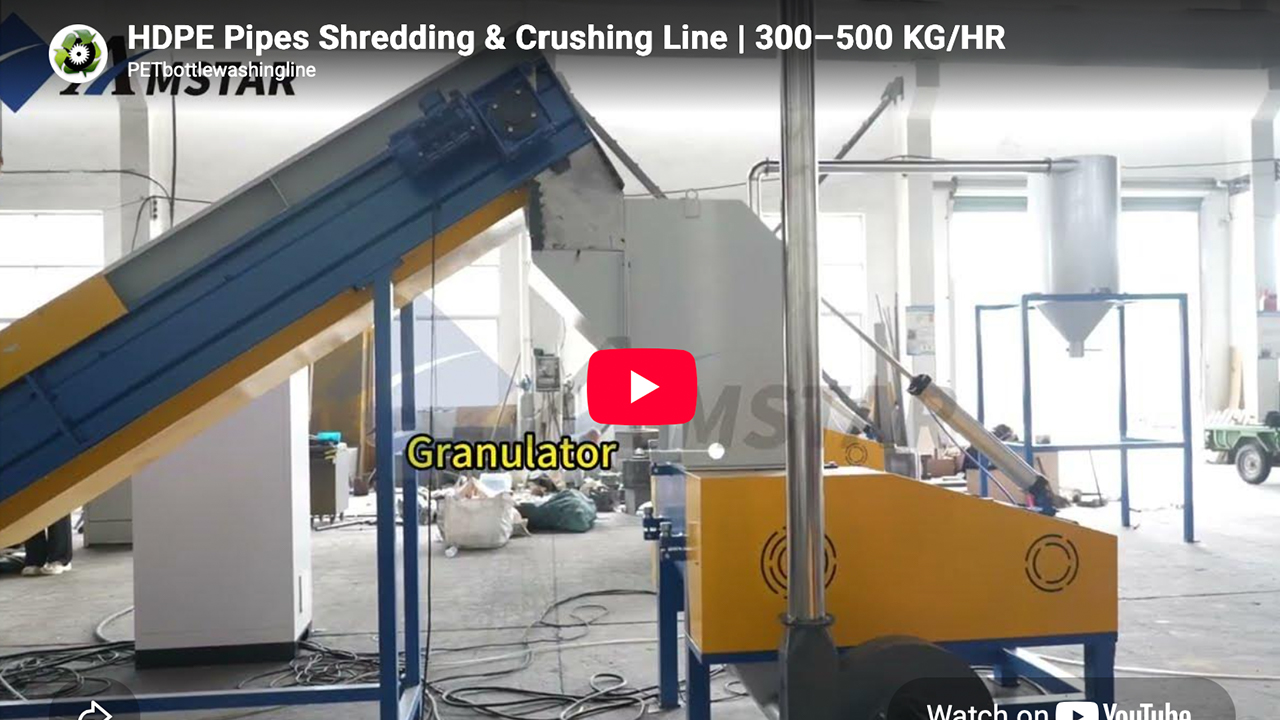
High-Density Polyethylene (HDPE) is one of the most widely used plastics across construction, industrial manufacturing, and municipal infrastructure. However, processing heavy-duty HDPE waste—such as long thick-walled pipes, large purge lumps, and headstock material—presents significant challenges for plastic recyclers. Standard recycling granulators often suffer from frequent jam-ups, excessive blade wear, or inadequate feeding power when dealing with high-density, bulky plastics.
To overcome these operational bottlenecks, modern recycling facilities rely on two-stage size reduction systems. In this post, we’ll explore how our 300–500 kg/hr HDPE Pipe & Headstock Shredding and Crushing Line automates the size-reduction process, optimizes energy efficiency, and converts tough plastic scrap into uniform, high-value regrind.
The Challenge of Recycling HDPE Pipes and Headstock Waste
HDPE is valued for its high strength-to-density ratio, impact resistance, and durability. While these properties make it ideal for water pipelines, gas conduits, and industrial parts, they make post-industrial and post-consumer waste notoriously difficult to reduce in size:
- Physical Dimensions: Long pipes are difficult to feed into standard hoppers without manual pre-cutting.
- Material Density & Thickness: Large headstocks (purge lumps from extruders) require immense torque and pressure to break down.
- Labor Costs & Safety Hazards: Manual loading and pre-cutting increase operational costs and expose workers to equipment risks.
To achieve a consistent particle size suitable for extrusion or pelletizing without overloading machinery, a continuous, automated two-stage process is required.
Step-by-Step Breakdown: The 300–500 KG/HR Two-Stage Recycling Line
Our integrated shredding and crushing system integrates intelligent automation with heavy-duty mechanical engineering to deliver continuous throughput with minimal operator intervention.
+-------------------+      +-----------------------+      +-------------------+
|  Automatic Belt   | ---> |  Single-Shaft Heavy   | ---> | Transfer Conveyor |
| Feeding Conveyor  |      |   Duty Shredder       |      +-------------------+
+-------------------+      +-----------------------+                |
                                                                    v
+-------------------+      +-----------------------+      +-------------------+
| High-Quality HDPE | <--- | Transit Storage Silo  | <--- | Heavy-Duty Plastic|
| Uniform Regrind   |      |   (Optional System)   |      |    Granulator     |
+-------------------+      +-----------------------+      +-------------------+
Step #1: Smart Interlocking Automatic Feeding
Efficiency begins at the intake. Long HDPE pipes and thick headstock waste are loaded onto the primary heavy-duty feeding belt conveyor.
- Automatic Interlocking Control System: The system monitors the load in the shredder hopper. When the hopper requires material, the intake door opens automatically, and the belt conveyor engages to feed the plastic waste inside.
- Controlled Loading: Once the optimal volume is loaded, the hopper door automatically seals, and the primary shredding cycle begins. This controlled sequence prevents machine jamming and maintains a steady processing rate.
Step #2: Primary Heavy-Duty Shredding (Single-Shaft Shredder)
Once inside the single-shaft shredder, heavy-duty components process the bulky material:
- Hydraulic RAM Pusher: A hydraulic ram steadily forces the HDPE pipes and thick solid lumps against the rotating rotor.
- High-Torque Size Reduction: The heavy-duty rotor, fitted with hardened steel cutting blades, gradually shears long, rigid pipes into manageable, coarse chunks.
- Reduced Mechanical Stress: By using a single-shaft shredder for primary reduction, the machine absorbs high impacts without stalling, protecting the secondary equipment downstream.
Step #3: Secondary Granulating into Uniform Regrind
After primary shredding, the discharge conveyor carries the coarse plastic chunks directly to the heavy-duty plastic granulator (crusher).
- Fine Granulation: The high-speed granulator grinds the shredded chunks down into small, highly uniform HDPE regrind.
- Ready for Re-Processing: The resulting regrind features consistent bulk density, making it ready for washing lines, pelletizing extruders, or direct injection molding.
Key Advantages of a Two-Stage Size Reduction System
Investing in a dedicated shredder-granulator combination offers several operational advantages over traditional single-stage crushers:
- Higher Energy Efficiency: Dividing the workload into a high-torque shredding stage followed by a high-speed granulating stage reduces overall peak power consumption and motor strain.
- Lower Maintenance & Longer Tool Life: Blade wear is reduced because the granulator receives pre-shredded material rather than handling raw, bulky pipes directly.
- Minimal Manual Labor: The automated interlocking system coordinates feeding, shredding, and crushing, enabling a single operator to manage the entire line.
- Versatility: Designed to process a broad range of challenging HDPE scrap—including extrudate lumps, pipe ends, profiles, drum scrap, and thick-walled containers.
Technical Specifications Overview
| Parameter | Specification |
| Throughput Capacity | 300 – 500 kg/hr (varies by material density) |
| Target Materials | HDPE Pipes, Headstock Lumps, Purge Waste, Bulky Scrap |
| Primary Machine | Single-Shaft Industrial Shredder |
| Secondary Machine | Precision Plastic Granulator / Crusher |
| Feed System | Automated Belt Conveyor with Interlocking Logic |
| Material Feed Assist | Hydraulic Ram / Pusher System |
| Final Product | Uniform, Low-Dust HDPE Regrind |
Upgrade Your HDPE Recycling Performance Today
Whether you are looking to process post-industrial pipe scrap or streamline your factory’s purge waste handling, an automated 300–500 kg/hr HDPE Pipe Shredding & Crushing Line offers the power, safety, and reliability your operations demand.
Looking for a customized recycling equipment solution? Contact our engineering team today to request a quote, technical consultation, or customized plant layout design
Inquiries
To get the latest prices and lead times, send us a message using the form below.