
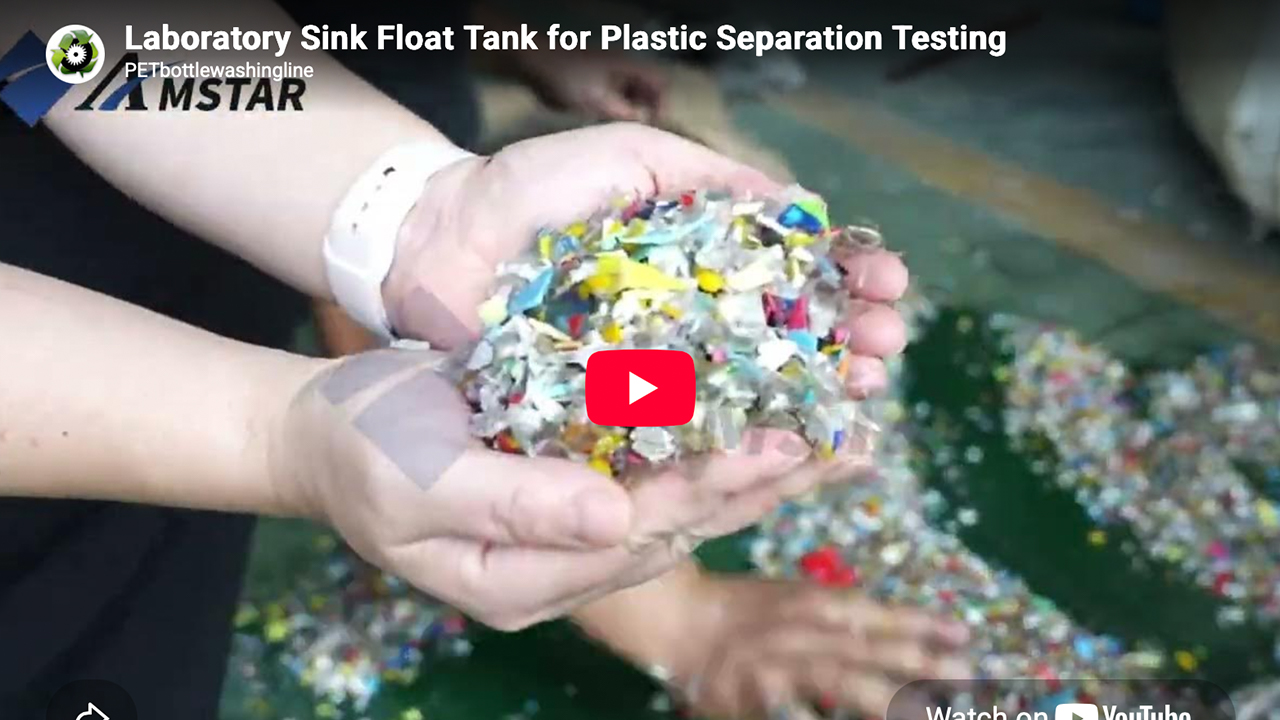
Video: Laboratory sink float tank separating sinking PET flakes and floating HDPE flakes through separate discharge outlets.
Before designing or selecting a plastic recycling process, it helps to understand how your materials behave in water. Do the plastic flakes sink or float? Can the mixture be separated into useful fractions?
Our Laboratory Sink Float Tank provides a compact platform for investigating these questions. Designed for plastic separation experiments, university research, material testing, and small-scale recycling trials, it allows users to observe density-based separation and collect the resulting materials for evaluation.
The video below demonstrates the process using a mixture of PET and HDPE flakes.
How Does a Laboratory Sink Float Tank Work?
A sink float tank separates materials according to their density relative to the separation liquid. In water, plastics with a lower density generally float, while plastics with a higher density generally sink.
This principle can separate conventional PET and HDPE flakes: PET sinks, while HDPE floats. Published research on mixed plastic separation also demonstrates this grouping using tap water.
The laboratory tank makes this process accessible for small-scale observation and testing. Rotating paddles move the material forward, while separate screw conveyors discharge the sinking and floating fractions.
PET and HDPE Separation: The Demonstration Process
The demonstration follows a straightforward sequence:
Mixed PET and HDPE flakes → Water separation → Sinking and floating fractions → Separate collection
1. Feed the Mixed Plastic Flakes
PET and HDPE flakes are mixed together before testing. After the machine starts, the mixture is slowly fed into the water-filled tank.
2. Observe Separation in Water
Inside the tank, rotating paddles gently move the flakes forward as the materials separate according to their different densities.
The PET flakes sink toward the bottom. The HDPE flakes remain on the water surface.
3. Collect the PET Flakes
The sinking PET flakes are extracted through the bottom screw conveyor and discharged for collection.
4. Collect the HDPE Flakes
The floating HDPE flakes are discharged through the side screw conveyor, creating a separate collected fraction.
Collecting material from different outlets allows users to inspect the separation results and identify any material carried into the wrong fraction.
Why Test Plastic Separation at Laboratory Scale?
Laboratory testing helps researchers and recycling teams evaluate a material mixture before committing to larger equipment or further process development.
A compact sink float tank supports:
- Direct observation: Study how samples behave during feeding, movement, and discharge.
- Separate sample collection: Collect sinking and floating fractions for further analysis.
- Material comparison: Compare results from different plastic samples.
- Process feasibility studies: Explore whether water-based density separation is suitable for a particular mixture.
- Teaching and research: Demonstrate plastic separation principles through practical experiments.
Laboratory results provide useful evidence for process development, although performance at production scale requires further validation.
Laboratory Testing vs. Industrial Separation
| Consideration | Laboratory Sink Float Tank | Industrial Sink Float Tank |
|---|---|---|
| Main purpose | Experiments and material evaluation | Production-scale separation |
| Material quantity | Small samples and trial batches | Larger processing volumes |
| Equipment scale | Compact testing unit | Full-size processing equipment |
| Main focus | Observing behavior and evaluating results | Meeting production and process requirements |
| Typical users | Universities, laboratories, and R&D teams | Plastic recycling plants |
Applications in Research and Recycling Development
The Laboratory Sink Float Tank is suitable for university and college laboratories, plastic recycling research centers, material testing laboratories, and equipment development teams.
Typical applications include evaluating PET and HDPE mixtures, conducting small-batch recycling trials, comparing sample behavior, and investigating separation steps for a proposed recycling process.
Testing can extend beyond PET and HDPE. However, water separation groups materials by their sink-float behavior; it does not automatically separate every polymer into an individual stream. Research shows, for example, that HDPE and PP can both enter the floating fraction, while several other plastics enter the sinking fraction. Source: mixed plastic separation study.
What Should You Evaluate During a Trial?
A useful trial goes beyond observing whether a sample sinks or floats. Consider recording:
- The composition and mass of the input sample.
- The mass collected from each discharge outlet.
- The presence of misplaced flakes in either fraction.
- Any material remaining in the tank after the trial.
These observations help assess separation performance. Measuring purity or recovery requires analysis of the collected fractions; visual observation alone does not establish either value.
Inquiries
To get the latest prices and lead times, send us a message using the form below.