
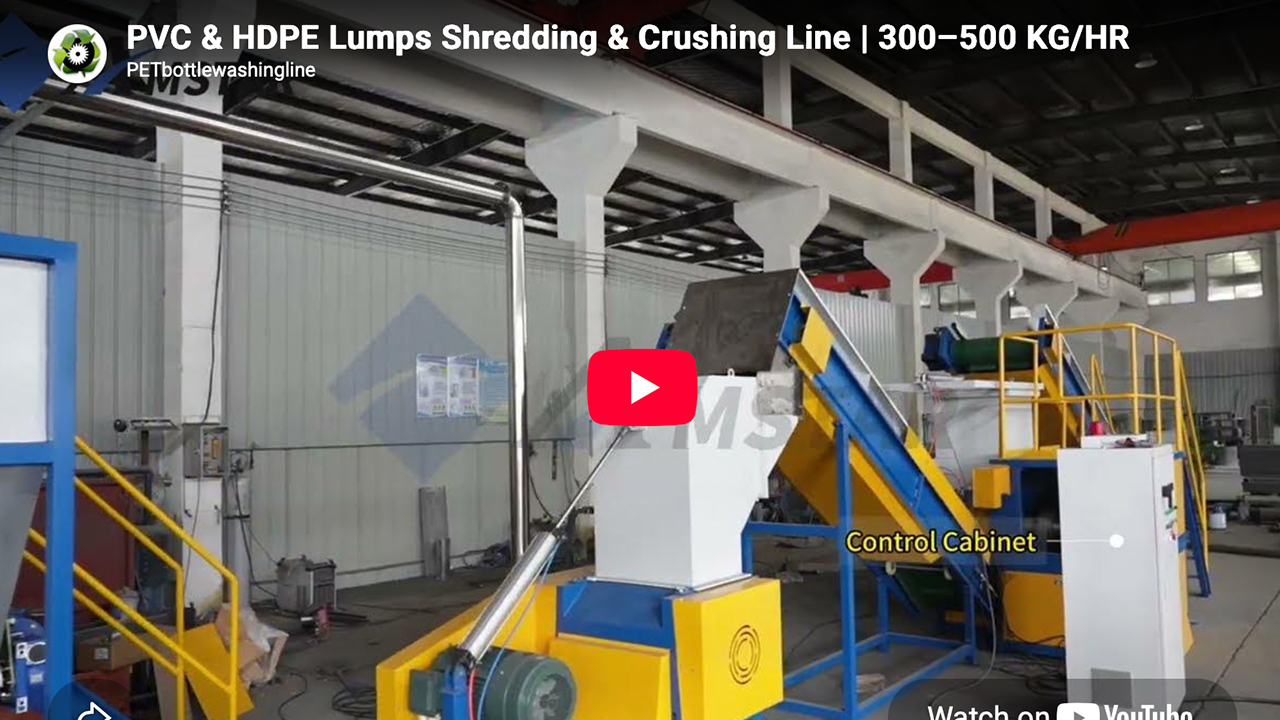
In plastic manufacturing and recycling facilities, dealing with heavy, solid, and bulky purge waste is one of the most demanding operational challenges. Large extruder headstock lumps, start-up purgings, and thick wall profiles made from high-density polymers like PVC and HDPE cannot be directly processed by standard granulators without causing blade breakage, motor stalls, or excessive power spikes.
To overcome these tough waste processing bottlenecks, an automated two-stage size reduction system is essential. In this guide, we explore how our 300–500 kg/hr PVC & HDPE Lumps Shredding and Crushing Line combines high-torque primary shredding with high-speed secondary granulating to process dense plastic waste into uniform regrind.
Why Heavy PVC & HDPE Purge Lumps Require Two-Stage Size Reduction
Polymers like Polyvinyl Chloride (PVC) and High-Density Polyethylene (HDPE) are selected for their rigidity, density, and impact resistance. However, when these materials consolidate into solid purge lumps or thick headstock scrap, they present severe processing hurdles:
- High Material Density: Extruder purgings are dense, solid blocks of plastic that require immense torque rather than high speed to break down.
- Machinery Wear & Tear: Attempting single-stage granulation on thick plastic lumps leads to rapid knife wear, frequent jam-ups, and severe mechanical stress on motor drives.
- Inconsistent Regrind Size: Direct crushing without prior shredding yields non-uniform, oversized chunks that disrupt downstream washing, compounding, or pelletizing lines.
A heavy-duty two-stage size reduction line solves these issues by dividing the workload between a low-speed, high-torque shredder and a fine-grinding granulator.
Process Breakdown: From Solid Lumps to Uniform Regrind
Our complete 300–500 kg/hr PVC & HDPE Lumps Line operates under a fully coordinated, automated interlocking control system. This ensures continuous material movement and balanced equipment loading at every stage.$$\text{Feeding} \longrightarrow \text{Shredding} \longrightarrow \text{Conveying} \longrightarrow \text{Granulation} \longrightarrow \text{Storage}$$
+---------------------+      +-----------------------+      +-------------------+
|  Feeding Belt       | ---> | Heavy-Duty Plastic    | ---> | Transfer Conveyor |
|     Conveyor        |      |    Lumps Shredder     |      +-------------------+
+---------------------+      +-----------------------+                |
                                                                      v
+---------------------+      +-----------------------+      +-------------------+
| Transit Storage     | <--- | Heavy-Duty Plastic    | <--- | High-Speed Fine   |
|   Silo / Bagging    |      |  Granulator / Crusher |      | Granulation Stage |
+---------------------+      +-----------------------+      +-------------------+
1. Controlled Conveyor Feeding
Heavy PVC and HDPE lumps are loaded onto the intake belt conveyor. Integrated automation monitors downstream hopper levels to ensure material is transferred smoothly without overloading the primary shredder.
2. Heavy-Duty Primary Shredding
Once material enters the shredder hopper:
- Hydraulic Ram Pusher: A heavy-duty hydraulic pusher steadily forces solid plastic lumps toward the rotating cutting rotor.
- High-Torque Shearing: Robust cutting blades on the heavy rotor shear through thick, bulky lumps, breaking them down into manageable, coarse chunks.
- Shock Absorption: Low-RPM, high-torque operation absorbs heavy mechanical shocks, protecting drive components.
3. Automated Material Transfer
Discharged coarse chunks fall onto the secondary transfer belt conveyor, which delivers a steady stream of pre-shredded material directly to the granulator.
4. Secondary Precision Granulation
The pre-shredded pieces enter the secondary plastic granulator (crusher):
- Fine Grinding: High-speed rotor blades grind the coarse chunks against fixed bed knives and a sized screen mesh.
- Uniform Regrind: The output is reduced to small, low-dust PVC or HDPE regrind with consistent bulk density.
5. Automated Regrind Collection
A pneumatic air-discharge system or transit conveyor moves the finished regrind into a storage silo or octabin, ready for immediate re-use, washing, or re-pelletizing.
Line Configuration & Equipment Specifications
| Equipment Component | Primary Function |
| Feeding Belt Conveyor | Automated intake feeding for heavy PVC & HDPE lumps and purge waste |
| Plastic Lumps Shredder | High-torque, low-speed primary size reduction with hydraulic ram feeding |
| Transfer Conveyor | Continuous material delivery from primary shredder to granulator |
| Plastic Granulator | High-speed secondary grinding for fine, uniform regrind production |
| Storage Silo | Regrind collection and temporary storage for downstream processing |
| Control System | Centralized electrical cabinet with smart interlocking logic |
Suitable Materials & Applications
This heavy-duty size reduction system is specially configured to handle a wide range of tough, high-density industrial plastic scrap:
- Extruder Purge Lumps & Start-up Scrap (PVC, HDPE, PP, ABS)
- Thick Wall Pipe Offcuts & Headstock Waste
- Injection Molding Purges & Runner Blocks
- Heavy Blow Molding Lumps & Drum Scrap
- Solid Plastic Sheets & Industrial Blocks
Key Benefits for Industrial Recyclers
- Higher Operational Throughput: Processing 300 to 500 kg/hr continuously without manual pre-cutting of large purge blocks.
- Optimized Power Consumption: Two-stage size reduction balances electrical load, eliminating high current spikes caused by heavy jam-ups.
- Reduced Labor Costs: Smart interlocking automation coordinates feeding and shredding, requiring minimal operator intervention.
- Extended Tool Life: Spreading size reduction across two specialized machines reduces knife wear and lowers overall maintenance costs.
Upgrade Your Plastic Scrap Processing Efficiency
Whether you are seeking to reclaim valuable internal factory purge waste or upgrade your commercial recycling plant, our 300–500 kg/hr PVC & HDPE Lumps Shredding & Crushing Line offers the durability, safety, and output quality required for tough plastic materials.
Inquiries
To get the latest prices and lead times, send us a message using the form below.