
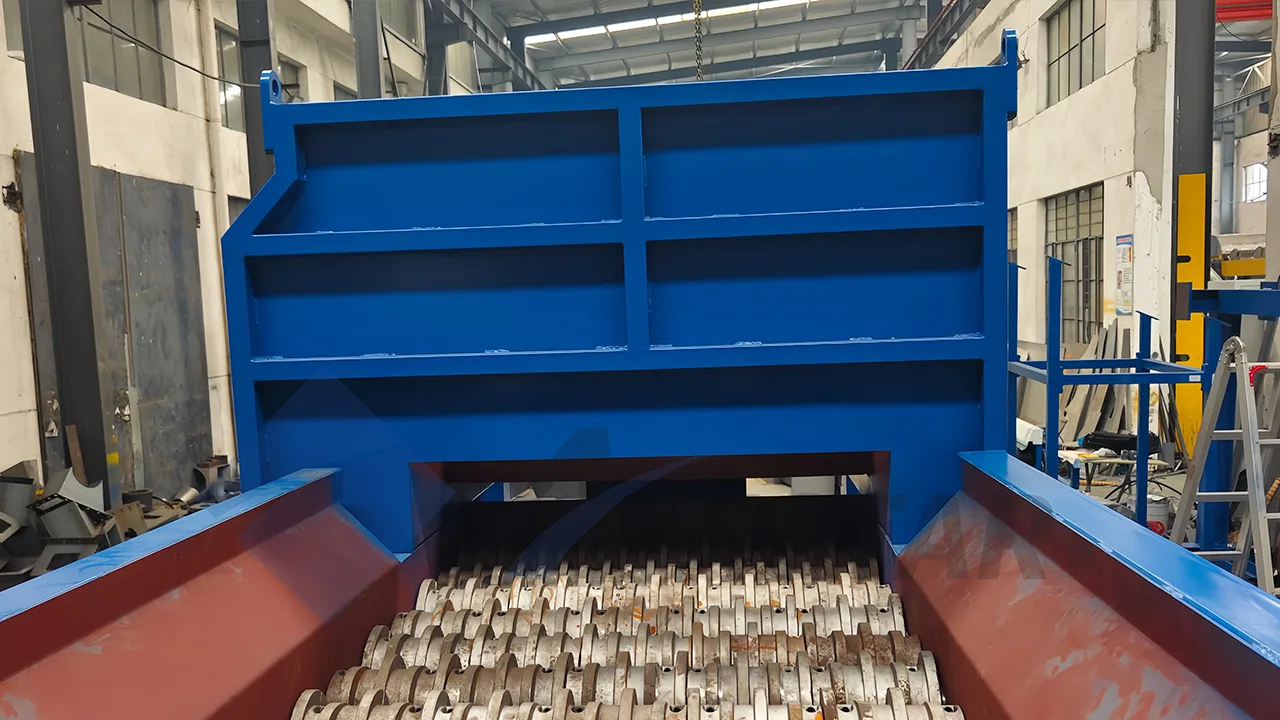
The Roller / Disc Screen is a high-performance, heavy-duty screening solution specifically designed for plastic recycling lines. Featuring multiple rotating shafts equipped with cast-steel or coated discs, this equipment excels at precise size-based separation, making it a vital pre-sorting unit for modern PET, HDPE, PP, and mixed plastic recycling systems.
Key Role in Plastic Recycling
- Size-Based Plastic Separation: Ideal for pre-classifying bottles, caps, films, and rigid plastics to improve the efficiency of polymer-type and color-based sorting downstream.
- Upstream to Optical Sorting: Ensures consistent particle size input to optical sorters, enhancing sorting accuracy and yield.
- Glass Breaking: In mixed waste or bottle recovery streams, the screen can also aid in breaking and removing glass prior to optical separation, minimizing equipment wear.
Advantages
- High Throughput & Low Maintenance: Handles high material volumes with reduced clogging and lower noise levels than traditional trommel screens.
- Anti-Wrap Disc Technology: Interlaced discs minimize material wrapping, reduce cleaning downtime, and ensure smooth operation.
- Versatile Sizing Options: Enables efficient separation and fines removal for precise material grading.
- Compact & Modular Design: Fits well into compact washing or sorting lines without sacrificing performance.
Configuration Options
Available in single-deck (XXS Series) and double-deck (YPS Series) layouts, tailored to match plant capacity and space constraints.
Single Deck – XXS100 SeriesThe Roller / Disc Screen is a high-performance, heavy-duty screening solution specifically designed for plastic recycling lines. Featuring multiple rotating shafts equipped with cast-steel or coated discs, this equipment excels at precise size-based separation, making it a vital pre-sorting unit for modern PET, HDPE, PP, and mixed plastic recycling systems.
Key Role in Plastic Recycling
- Size-Based Plastic Separation: Ideal for pre-classifying bottles, caps, films, and rigid plastics to improve the efficiency of polymer-type and color-based sorting downstream.
- Upstream to Optical Sorting: Ensures consistent particle size input to optical sorters, enhancing sorting accuracy and yield.
- Glass Breaking: In mixed waste or bottle recovery streams, the screen can also aid in breaking and removing glass prior to optical separation, minimizing equipment wear.
Advantages
- High Throughput & Low Maintenance: Handles high material volumes with reduced clogging and lower noise levels than traditional trommel screens.
- Anti-Wrap Disc Technology: Interlaced discs minimize material wrapping, reduce cleaning downtime, and ensure smooth operation.
- Versatile Sizing Options: Enables efficient separation and fines removal for precise material grading.
- Compact & Modular Design: Fits well into compact washing or sorting lines without sacrificing performance.
Configuration Options
Available in single-deck (XXS Series) and double-deck (YPS Series) layouts, tailored to match plant capacity and space constraints.
Single Deck – XXS100 Series

| Model | Motor power | Screen hole Size | Screen width |
| XXS100-15 | 2*5.5 kW | 35*42mm/50*50mm/100*100mm | 1100mm/1100mm/1320mm |
| XXS100-18 | 2*7.5 kW | ||
| XXS100-21 | 2*11 kW |


Double Deck – YPS100 Series

| Model | Motor power | Screen hole Size | Screen width |
| YPS100-15 | 4*5.5 kW | 35*42mm/50*50mm/100*100mm | 1100mm/1100mm/1320mm |
| YPS100-18 | 4*7.5 kW | ||
| YPS100-20 | 4*11 kW |


Primary Applications in Plastic Recycling
- PET Bottle Recycling Lines: Pre-sorting bottles, caps, and labels by size before washing and optical sorting.
- PE/PP Film and Rigid Plastic Pre-treatment: Enhances washing, flotation, and pelletizing performance by ensuring consistent feed sizes.
- Optical Sorting Feed Preparation: Removes oversized or undersized particles to stabilize optical sorter throughput and accuracy.
- Glass Contaminant Reduction: In mixed plastic or municipal streams, aids in breaking/removing glass prior to optical or eddy current separation (optional).
By integrating the Roller / Disc Screen into your plastic recycling line—whether for bottle flakes, films, or rigid materials—you ensure a smoother, cleaner, and more efficient sorting process.
Frequently Asked Questions
The Roller / Disc Screen is a heavy-duty pre-sorting unit that separates material by size using multiple rotating shafts fitted with cast-steel or coated discs. It is used in PET, HDPE, PP, and mixed plastic recycling systems for bottle flakes, films, and rigid materials.
The XXS100 series is a single-deck layout and the YPS100 series is a double-deck layout, chosen to match plant capacity and space constraints. XXS models use two motors of 5.5, 7.5, or 11 kW; YPS models use four motors of the same ratings.
Single-deck models range from the XXS100-15 with 2 × 5.5 kW to the XXS100-18 with 2 × 7.5 kW and the XXS100-21 with 2 × 11 kW. Double-deck models run from the YPS100-15 with 4 × 5.5 kW through the YPS100-18 with 4 × 7.5 kW to the YPS100-20 with 4 × 11 kW.
Screen hole sizes are 35 × 42 mm, 50 × 50 mm, or 100 × 100 mm, with corresponding screen widths of 1100 mm, 1100 mm, and 1320 mm. The same hole size and width options apply to both the single-deck XXS100 and double-deck YPS100 series.