
What plastic recyclers should know about bearings, reliability, and conveyor design.
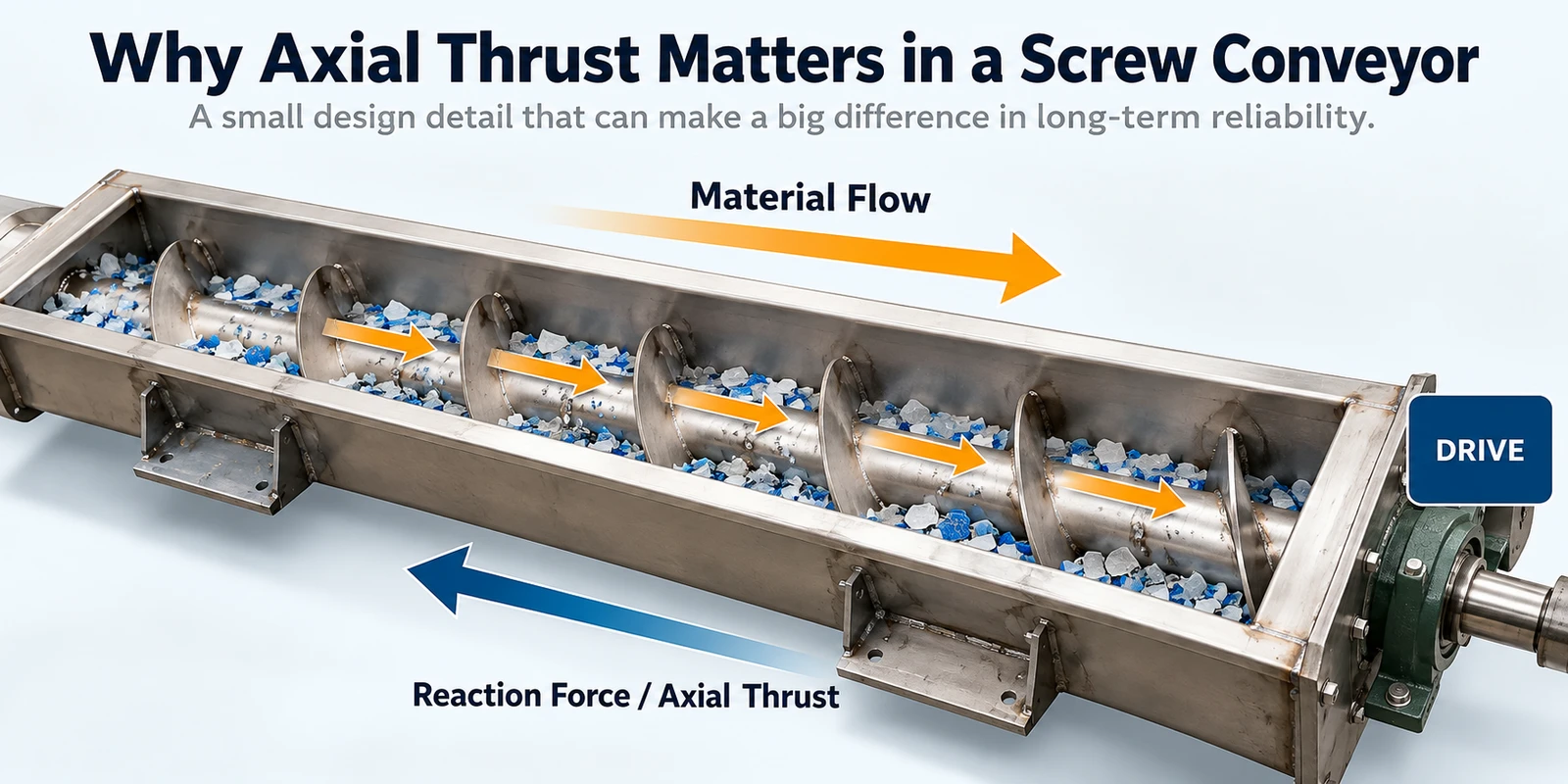
A screw conveyor may look like a simple piece of equipment: a motor turns the screw, and the screw moves material from one machine to the next. But inside the conveyor, the screw is not only rotating – it is also continuously pushing against the material.
That pushing action creates an opposite force on the screw shaft. This is called axial thrust. If it is not properly considered in the conveyor design, it can contribute to bearing overheating, shaft movement, seal wear, abnormal noise, or even contact between the screw and housing.
For customers, the key point is simple: a reliable screw conveyor depends on more than motor power and screw diameter.
1. Where Does the Axial Thrust Come From?
As the screw rotates, its helical flights push plastic flakes, regrind, pellets, or other material toward the discharge. The material naturally pushes back against the screw. This reaction force is transferred from the screw flights to the shaft and finally to the bearing and supporting structure.
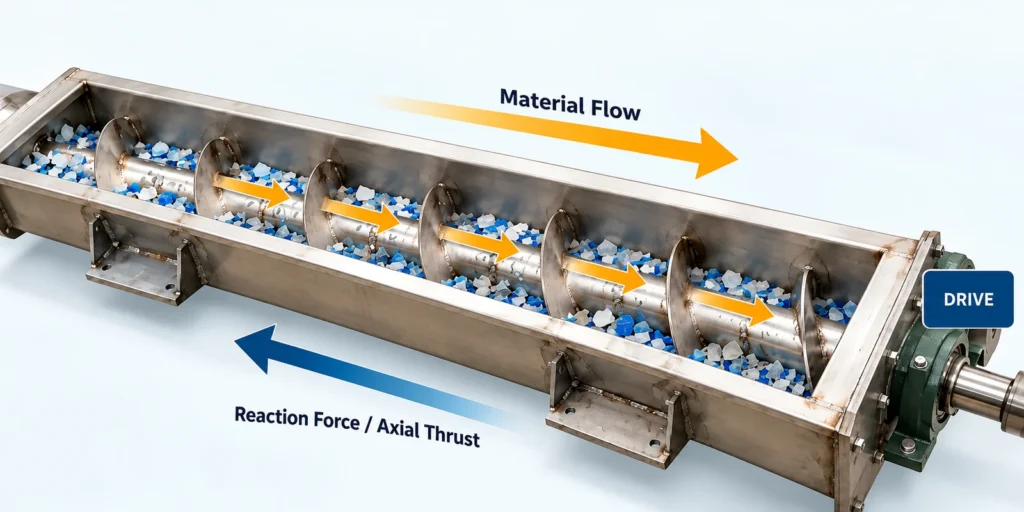
The actual load changes with the application. A conveyor handling dry HDPE regrind may behave differently from one moving wet PET flakes or lightweight film. Feed rate, material friction, filling level, conveyor angle, and discharge resistance can all change the load on the shaft and bearings.
2. Why Should a Buyer Care About This?
Axial thrust is usually invisible during normal production. Problems often appear only after the machine has been running for some time or when operating conditions become more demanding.
| Operating condition | What may happen | What good design should consider |
|---|---|---|
| Stable, normal feeding | Load remains relatively steady | Correct bearing and shaft arrangement |
| High feed rate / full load | Higher resistance and shaft load | Sufficient design margin |
| Wet or sticky flakes | More friction and possible buildup | Material-specific screw design |
| Blocked or restricted discharge | Material can compact inside the conveyor | Protection against abnormal load |
| Long-term continuous operation | Heat, wear, and expansion become more important | Reliable locating and non-locating bearing arrangement |
This is why two screw conveyors with similar dimensions can have very different service lives when they are used for different materials or operating conditions.
3. Does Screw Pitch Matter?
Yes. Screw pitch affects how the rotating screw moves material forward. A shorter or longer pitch changes the relationship between rotation, material movement, filling behavior, and the forces acting on the screw.
However, customers do not need to calculate axial thrust from pitch alone. In a real recycling line, material slip, moisture, friction, conveyor angle, and loading condition all affect the result. The screw pitch should therefore be selected as part of the complete conveying design – not as an isolated parameter.
A “standard screw” is not always the best screw. The material and the application should determine the design.
4. What Is the Role of the Thrust Bearing?
The bearing system keeps the screw shaft running in the correct position. One part of the bearing arrangement supports radial loads, while the locating bearing or thrust-bearing arrangement controls axial movement and carries the required axial load.
For longer conveyors, it is generally important to avoid rigidly locking both ends of the shaft without considering thermal expansion and installation tolerances. A well-designed system normally has a clear locating end and a non-locating end so that the shaft can remain controlled while still allowing necessary movement.
5. What Should Be Considered When Selecting a Screw Conveyor?
For a plastic recycling project, bearing selection should not be separated from the rest of the conveyor. The complete operating condition needs to be considered first.
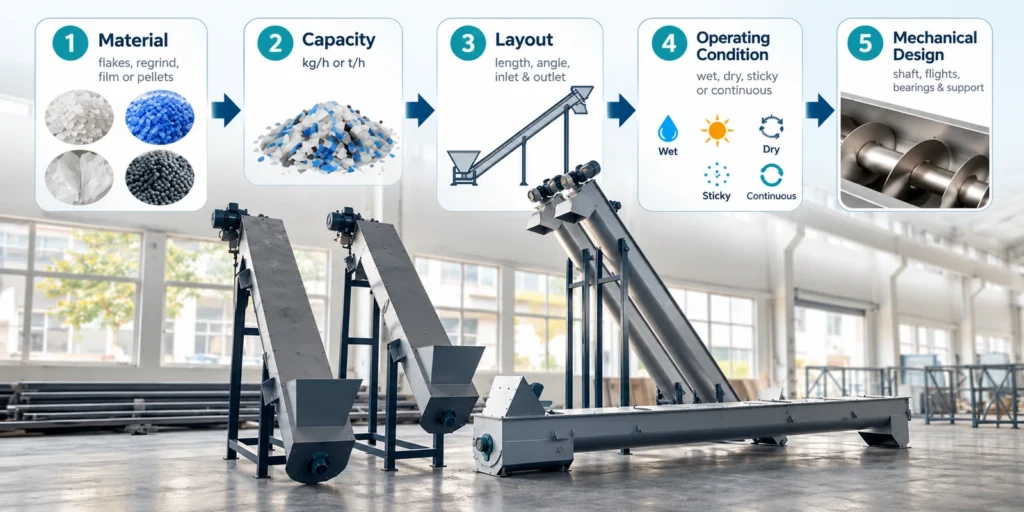
Before requesting a screw conveyor, it is useful to provide:
- Material type and approximate bulk condition
- Required capacity in kg/h or t/h
- Conveying distance and installation angle
- Inlet and discharge height
- Whether the material is wet, dry, sticky, fluffy, or abrasive
- Expected daily operating hours and whether full-load starts may occur
6. A Better Screw Conveyor Starts with the Application
In plastic recycling lines, screw conveyors are often used between washing tanks, friction washers, dewatering machines, dryers, storage systems, and pelletizing equipment. Although they are auxiliary machines, their reliability directly affects the continuity of the complete line.
Our approach is to match the screw diameter, pitch, shaft structure, bearing arrangement, material-contact parts, inclination, inlet/outlet design, and drive configuration to the actual recycling application.
Quick Selection Guide
| Your application | Design focus |
|---|---|
| Dry plastic flakes / regrind | Stable feeding, wear resistance, suitable capacity |
| Wet flakes after washing | SUS304 contact parts, drainage, bearing protection |
| Lightweight film / fluff | Feeding stability, anti-bridging design, suitable pitch |
| Long or inclined conveying | Shaft rigidity, bearing arrangement, drive sizing |
| Continuous heavy-duty operation | Design margin, bearing life, easy maintenance |
Conclusion: Do Not Choose a Screw Conveyor by Capacity Alone
When comparing screw conveyors, capacity and motor power are easy to see on a quotation. The less visible details – shaft loading, screw geometry, bearing arrangement, expansion allowance, and supporting structure – are often what determine long-term reliability.
For a new plastic recycling line or a replacement conveyor, send us your material photos, target capacity, conveying distance, inlet/outlet height, and operating conditions. We can recommend a screw conveyor configuration that fits the actual process instead of simply offering a standard size.
Need a screw conveyor for PET, HDPE, PP, PE, PVC flakes, regrind, pellets, or wet material? Send us your application details for a customized recommendation.
INQUIRIES
To learn more about this topic or get prices and lead times for the machinery mentioned, please send us a message using the form below.